
The Mvet : The Musical Epic of Central Africa Inscribed on UNESCO’s Heritage List
It is both a stringed instrument and a epic tale, a spiritual bridge and a living archive. On December 11, 2025, the Mvet Oyeng was officially inscribed on UNESCO’s Representative List of the Intangible Cultural Heritage of Humanity, marking a historic milestone for the Ekang peoples of Gabon, Cameroon, the Republic of Congo, Equatorial Guinea, and São Tomé and Príncipe
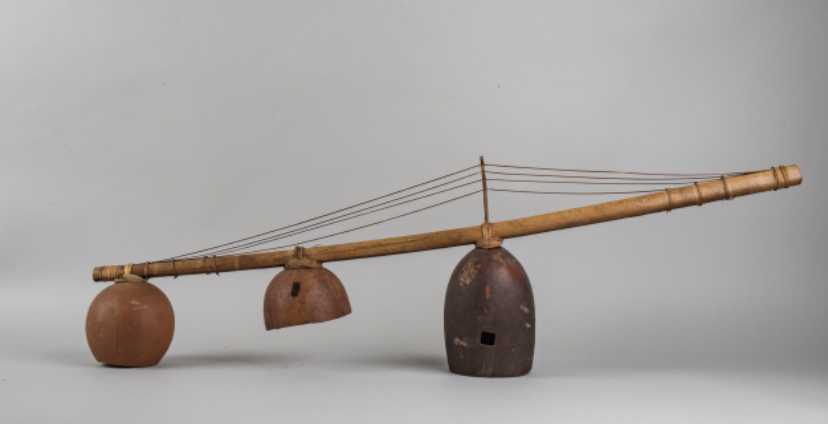
photo credit: Google
The term « Mvet » actually designates three inseparable elements that form a coherent system. First, there is the instrument itself: a stick zither measuring between one and two meters in length, made from a stalk of bamboo or raffia palm. It typically features three calabashes serving as resonators and four to five strings made of fibers or metal, stretched on either side of a central bridge. The instrument is held horizontally across the chest, and the musician plays on both sides of the bridge. Second, there is the epic narrative, called Nlan Mvet, which is recited before an audience. These epics, with an average duration of seven hours, glorify mythical heroes and explore the quest for immortality, recounting the exploits of the divine race of the Ekan and the mythical world of Engong. Third, there is the storyteller-musician known as the Mbom Mvet, a complete artist who functions as orator, musician, poet, and singer all at once, reciting the epic while playing the instrument. His performance requires exceptional oratorical dexterity called elat mvet and a thorough mastery of the entire corpus of epic tales.
A Tradition Between the Sacred and the Popular
The Mvet exists in two complementary forms that serve different social functions. The sacred form is reserved for important events and follows a strict initiation process for its transmission, as it is rooted in ancestral spirituality and serves as a bridge between the world of the living and the world of the dead. The popular form, by contrast, is more flexible and accessible, performed during public celebrations and modern shows, and in this context women can be storytellers, even if they generally do not build the instrument. Regardless of the form, the audience participates actively in the performance: seated around the storyteller, spectators strike sticks or clap their hands, sing, and engage in dialogue with him throughout the recitation.
Legend and Initiatory Transmission
According to Fang legend, the mvet is not a simple human invention but rather a divine revelation. It was revealed to the warrior Oyono Ada Ngono during an altered state of consciousness that he experienced in the midst of battle. Upon waking, he built the instrument to restore courage and hope to his people, thereby initiating a tradition that has been passed down for generations. Becoming a mbom mvet requires a long apprenticeship within traditional schools, where the initiation follows precise steps. These steps range from the revelation of origins and lineages to the knowledge of the cycles of nature and the psychology of beings. As Professor Grégoire Biyogo, recognized as the father of « mvettology, » emphasizes, the primary role of the Mvet is not merely to be listened to, thought about, told, or written down, but rather to achieve a form of human transmutability.
A Historic Recognition for Central Africa
This UNESCO inscription is the culmination of a joint effort undertaken since 2018 by the ministries of culture of Gabon, which led the operational effort, along with Cameroon and the Republic of Congo, with the support of UNESCO and the involvement of practitioner communities. National consultations were held in Libreville and Oyem in 2018 and again between 2022 and 2024, while the town of Ebolowa in Cameroon hosted the joint meetings. For Gabon, this inscription is a historic first, as the Mvet becomes the first Gabonese element to join UNESCO’s intangible heritage list. This source of national pride materialized with the celebration of the first National Day of the Mvet Oyeng on March 22, 2025, at the National Museum of Arts in Libreville.
A Promising Future: Festival and Museum
Buoyed by this international recognition, the states of the sub-region are now planning ambitious projects to perpetuate and enhance this heritage. Among the most significant initiatives are the creation of an international Mvet festival, which would serve as a platform for cultural and scientific expression bringing together artists, researchers, and enthusiasts from the sub-region and beyond. Another major project is the construction of a Mvet museum, to be located in the strategic area known as the « three borders, » at the junction of Gabon, Cameroon, and Equatorial Guinea. This highly symbolic location reflects the cross-border nature of this shared heritage. Additionally, the regular organization of scientific meetings is planned to better document and transmit knowledge related to the Mvet, strengthening its place in academic circles. These initiatives aim to make the Mvet not only a vehicle for cultural education for younger generations but also an instrument of heritage diplomacy and regional integration.
The Mvet Oyeng continues to inspire modern music, having become a key instrument of Cameroonian bikutsi in the 20th century, while remaining a living symbol of the cultural richness of Central Africa. Its recognition by UNESCO opens the way for enhanced transmission of this unique heritage, where the quest for immortality of mythical heroes still resonates powerfully in today’s narrative.
#MvetOyeng
#UNESCO
#IntangibleHeritage
#CentralAfrica
A great recognition for the Ekang people